
American trend research company Pew Research has been publishing warning signs since 2008, with its seminal paper:When Bad Times Hit the Good Life in which it demonstrates how increasingly large numbers of middle income people in that country were not making economic progress: if anything, they were falling behind. Years later, Pew released an even more strident paper entitled The Hollowing out of the American Middle Class, where it signalled the beginning of the trend towards the “hourglass society”.
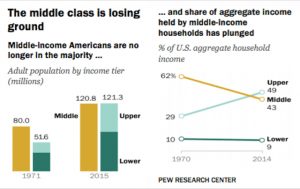
It warned readers that “middle-income households” no longer constituted the majority of American society – Instead, the majority of households were emerging as either low or higher-income. The study went on to say that, “Once in the clear majority, adults in middle-income households in 2015 were matched in number by those in lower- and upper-income households combined.” These findings “a demographic shift that could signal a tipping point” in American society.
Years later UK publications on both the left and right wing sides of the political spectrum have noted the decline of the middle class across the UK and Europe. However, evidence also suggests that while the room at the top is saturated as ever, the room near the top may in fact be growing at rates we have never before envisaged. As we enter our next big industrial revolution – the Age of Automation – we see that while jobs that require undertaking repetitive tasks, such as filling out forms, or operating machinery are at greater risk of being taken by robots. At the same time, industries are crying out for skilled workers, and newer roles, such as the much-revered ‘data scientist’ is predicted to be in soaring demand.
This is why the time for an education revolution is now: we need to adopt what Boston Consulting Group calls “The Accelerator Mindset” and embed this more ambitious, audacious and adaptive thinking within our educational institutions, so we can radically up-skill young people in full time education, as well as adults looking to develop (or in need of developing) their skills.
However we know that schools’ budgets are punishingly low and teachers’ hours are long and gruelling, so we cant place this burden on educators alone. Families are under pressure more than ever before, with many people being labelled as ‘JAMs’ (just about managing) because of the need to take on additional work to keep their families afloat. It is simply not realistic to suggest that parents do more in terms of offering pastoral care and extra curricular activities. They also have enough on their plates.
Just like accelerators they need real financial investment and mentorship – this should arguably come from the businesses that will need these people as employees; in short – the private sector needs to fund this, and in effect ‘pay for its own pipeline’. We could take this further – with a growth in educational tech firms, there is an even stronger argument to say that VCs should also get involved financially; after all if we do indeed ‘accelerate everyone’ – we have the chance of creating a highly skilled society that can compete powerfully on the global stage. Our aim is simple: we need to make it our principal aim to get everyone into the high skilled half of this hourglass, as if it were a basic requirement.
I don’t think this is at all impossible; we made the UK in to a mature digital market shortly after the explosion of what was initially called “web 2.0” (remember that?) and now the vast majority of the UK populace has digital embedded into their everyday lives and as a result are digital natives. We absolutely can and must do this.
In the same way that we wouldn’t want the UK to have a majority of people unable to use the internet, we also cannot afford to have the majority of the country left behind and unable to participate in economic growth. In this light, social mobility is no longer to be seen as a CSR play, it is now a fundamental building block for the progress of this country – the productivity and political stability and economic future of the UK is at stake.
Also published on Medium.