
So it happened: workplace 2020 is only 2.5 years away – a blink of an eye in terms of how futurists see things. This is what came to mind after seeing the much discussed article about the 10 skills needed to survive the Fourth Industrial Revolution, initially published in January 2016. It flagged the move away from more linear thinking and skills most commonly needed in ‘command d control’ working cultures, towards those that demand creativity and emotional intelligence.
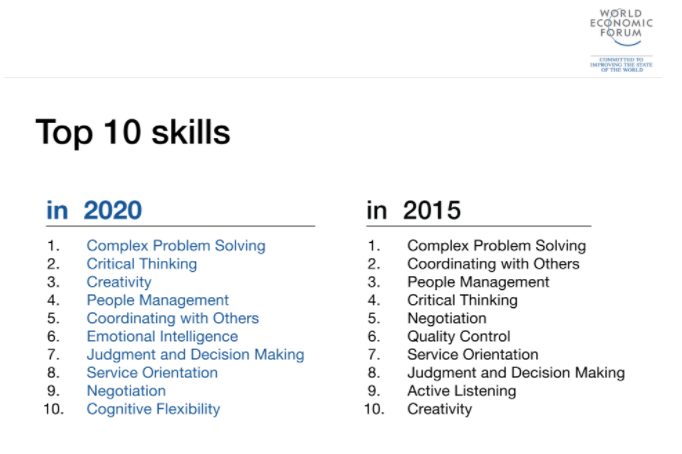
This in and of itself heralded at exciting shift in thinking; acknowledging the role that empathy (in this case articulated within the catch-all term emotional intelligence) needs to play within leadership and team co-operation: after all, a vastly changing environment is also one that for many is fraught with anxieties. It is exactly these anxieties (or rather, the dysfunctional and resistant behaviours that appear as a result of these fears) that can stop desired team outputs from happening at all. So arguably, learning how to lead mindfully and in a nurturing way that helps assuage these fears is vital.
Creativity had to be there: since 2015 Nesta has been lobbying the government to plan for a million extra creative jobs in order to prepare for the working world in 2030. Some have gone so far as to suggest that all but the most creative – and most caregiving – roles are at risk of at least partial automation.
The challenge here of course is that every year that passes a new skill needs to be added, and others removed or at least reconsidered. Futurist and researcher Stowe Boyd was right to suggest that a year later that the list has already become outdated. For instance, where is Design Thinking? This is something that will be essential especially in the worlds of engineering with AI when we are thinking not only of what tech will do, but how we can design and deploy AI to work alongside humans rather than render humans entirely useless.
Another surprising omission was that of business acumen; we are facing a world in which the new capabilities for tech are being uncovered with every passing day; experts are beginning to wake up to the huge potential of blockchain to enable and underpin a more secure transparent and accountable internet. While we’ll of course need technologists to uncover its potential, business building skill sets will be even more necessary to bring this potential to life in the market. The figures support this hypothesis: entrepreneurship is on the rise, which is unsurprising: with widening job insecurity caused by the growth of the gig economy and layoffs as a result of automation together with a host of other well-established factors, entrepreneurs (and ‘intrapreneurs’ that are up to the challenge of lifelong learning) are among those that appear better positioned to take advantage of the years ahead.
Ultimately the key challenge is that planning for a horizon that far out may be problematic, due to the pace of change. Hasan Bakshi of Nesta following the publication of a report last year on ‘Workplace 2030’ went so far as to suggest that robots themselves would decide what those skills would be, rather than us. Perhaps collaborating with AI will help us gain a clearer answer in future.