
Many of the articles that talk about the oncoming Fourth Industrial Revolution focus on the the roles that are most likely to be lost – driving taxis, working on assembly lines, even filing accounts. Only last month there was news of a breakthrough in the capacity of learning machines: Alphabet’s AI research arm, DeepMind, announced that it has built a final version of the AlphaGo Zero robot, that has mastered the Chinese strategy board game “Go” to the degree that it has beaten world champion Lee Sedol by 100-0.
This development drew attention due to the way in which AlphaGo Zero learned to master the game. Instead of analyzing data from Go games humans have played before, like most learning machines do – taking their cues from initial human input – it learns only by playing the game against itself. Serial tech entrepreneur Elon Musk’s OpenAI initiative used similar techniques to train an AI playing a video game— but AlphaGo’s ;earning capacities demonstrate on of the most powerful examples of the technology to date.
The idea of a self learning machine isn’t limited to the world of deep tech — In an event exploring the uses of haptics, VR and learning machines, they have a place in the arts as well. Ruairi Glynn installation artist and Director at the Interactive Architecture Lab at the Bartlett School of Architecture showed an installation featuring a machine that taught itself how to walk with no prior instruction from humans. This has huge implications; these machines could not only learn from us, but also independently of us and come up with smarter more efficient ways of carrying out mundane tasks.
But where does that leave us? The roles that appear to be least at risk of automation are the most creative; artists, musicians, writers – according to a report by Nesta on the impact of robots on the creative economy, skills such storytelling, performing, managing others, and consulting were more protected from the impacts of automation.
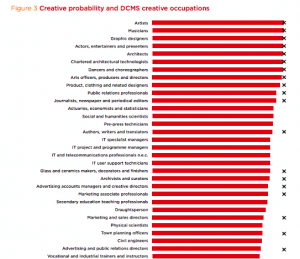
The report goes on to explain that a higher share of creative employment in the United Kingdom largely stems from its higher proportion of jobs in the Education, Legal, Community Service, Arts and Media category, which constitutes 11.2 percent of the total UK workforce relative to 9.6 percent in the United States. So in future there may be (or need to be) more jobs in that category for people to stay in employment.
This by no means suggests that all creative roles involve those that are entirely independent of machines; there is also a middle ground in which the synergy between humans and machines show promise, as illustrated in Ruairi’s 2013 paper on adaptive architecture in which humans design buildings that can change to fit their environments. Even now, many consultants in professional services work with smart machines every day.
There is now a need to rethink how we treat and design careers – this TED talk entitled “Why the jobs of the future won’t feel like work” explores the idea of building more meaningful career options for future workers. Currently we still define many jobs outside of the world of entrepreneurship, education, comms and the arts as a relatively narrow set of procedural tasks which are performed for set amount of time and rewarded.
We’ve created narrow job definitions like cashier, loan processor or taxi driver and then asked people to form entire careers around these singular tasks.
David Lee at TED@UPS
In the future, we’ll need to create roles and educational processes that centre less on a set of discrete on tasks, and more of a set of core skills and competencies. Here for instance is an example of the types of competencies that the World Economic Forum has recommended that we focus on in the near future:
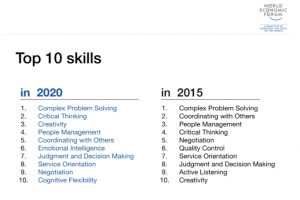
Because human beings have the capacity to unite technical capability and soft skills (like leadership) with creativity when faced with new and challenging problems and client briefs. Work will be less structured, more intellectually challenging and more like the roles that entrepreneurs and engineers do now.
Younger people coming into the workplace could instead get to cut their teeth immediately on bigger, meatier and more meaningful projects, rather than busying themselves with less productive activities like filing and data entry. This will of course necessitate a change in mindset; with great creative freedom comes great responsibility; and robots can be used to provide the checks and balances to guard against damaging human error.
So managers and directors today have a task ahead: we need to think deeply about the tasks that will be automated over the next few years. We need to stop training people (from school onwards) to enter these roles and instead plan for more the meaningful, valuable, rewarding and creative careers that will replace our old jobs. Technology will soon no longer be a sector – “I work in tech” will be a redundant phrase. Instead technology and data will underpin everything we do, and it is our responsibility to ensure we create a working world where they support us in realising our capacity for collective self-actualisation.
Further reading: 6 ways to make sure AI creates jobs for all and not the few/World Economic Forum