
The launch of the Social Mobility Employer Index marked an exciting evolution in the world of work; one in which employers begin to develop detailed, systemic metrics – set either by the industry or internally within the business – that track exactly how effective their inclusion initiatives are in creating the socially mobile society we want.
Last week, a list of the 50 UK-based companies across all sectors that had taken the most effective action to demonstrate social mobility in the workplace were highlighted, in what appears to be the first Index of its kind. It ranks Britain’s employers on the actions they are taking to demonstrate openness to sourcing and developing talent from all backgrounds.
The Social Mobility Foundation and Social Mobility Commission, two organisations that partnered to launch the Index also encourage firms to share their initiatives and progress in tracking inclusion – with time, we can expect to see increasingly sophisticated metrics that illustrate which sectors and companies are taking the issue of social mobility most seriously.
The beginning of inclusivity tracking
Tracking inclusive businesses began with a focus on diverse representation in terms gender and race – in line with the longstanding civil rights and feminist movements concerted efforts to drive change. Therefore the discussion was often centred around achieving quotas in hiring. The challenge came when diverse hiring attempts meet non-inclusive business cultures; or when there are no longer term KPIs within the business to nurture those from diverse backgrounds, so they can progress through their careers, and it is given away – rather alarmingly – by the metrics that are used to measure ‘success’ – if you could call it that.
I wish I could say the list below (thanks Workplace Diversity Network) were either a) a joke or b) from the 50s, but no. The list was published in 2012:
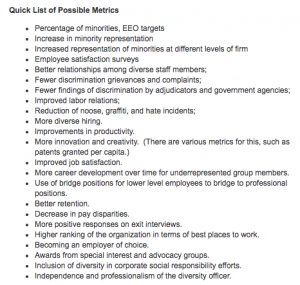
Reduction of hate incidents? Decrease in pay disparities? How about none of those things in the first place!
There is a helpful out-take from this however – as Project Include rightly states: measuring the right things is hard. It’s easy to focus on ‘quick wins’ like cosmetic changes, however, it’s looking at the systems and working out how to measure those that gets really tricky. Measuring things like inclusive cultures are hardest to track – after all, employers that rely on exit interviews won’t get the full picture as it depends how close the exit interviewer is to the team being appraised; leavers may not want to be completely unguarded if they are relying on that employer for a reference. Helpfully, Project Include also lists a selection of measurement approaches on its site.
In the UK there has been some progress in defining metrics that track the progress of inclusion and social mobility, which is even more important, because while representation is one part of the picture, tracking who enters the businesses, who progresses and where they end up matters the most. An example of this first appeared in the UK government last year, in which a series of suggested measurements for improving social mobility in the workplace were launched.
Ironically also last year a report was launched flagging the rock bottom rates of upward mobility based on background in the country at present. It makes sense that the private sector should be the standard bearers of social mobility – this is where the innovation and most of our growth happens – so it only makes sense that we seek to include as many people as possible in that growth story regardless of background.
What’s more, the role that metrics play in this process is to track what actually works and what is just cosmetic. Hosting a “tech inspiration day” at a nearby school is not going to produce the UK’s equivalent of Elon Musk; but long term engagement with young people starting while they are still at school – and measuring the progress of that engagement effectively, and tweaking the approach year after year – is much more likely to. Business In The Community, an organisation that has also been following the outcomes of the Social Mobility Employer Index, has made some compelling and measurable recommendations regarding what employers can do to actually disrupt the negative trend of social stagnation that we see in this country.
Ultimately the future of inclusivity tracking focuses on driving systemic over cosmetic change, favours long term transformation of the talent pool over ‘quick wins’, starts at school, and applies learning (skills) and unlearning (biases) throughout a person’s working life.
Also published on Medium.